Quick checklist
Before you pay:
- Is the seller UGG's own website or store, or a retailer you can confirm carries the brand?
- Is the web address exactly the brand's or the retailer's real domain, not a look-alike with "ugg", "outlet" or a style name in it?
- Is the discount believable? Steep discounts on current, in-demand styles are a classic warning sign.
- Does the site have clear contact details, a real returns policy and payment by card or another method with buyer protection?
- On a marketplace or social media, does the seller have a history, real photos of the actual item and answers to your questions?
When the pair arrives:
- Find the security label inside the left shoe or boot, tilt it, and scan its QR code if it has one.
- Check the lining, stitching, sole and labels against the official product photos for the same style and color.
- Keep the box, packaging, order confirmation and listing screenshots until you are sure.
Where to buy safely
The lowest-risk places to buy are UGG's own website (ugg.com and its regional versions), UGG brand stores and outlets, and established retailers that carry the brand, such as department stores and shoe stores. UGG's website includes a store finder for locating stores near you that carry its products. If you are unsure whether a particular shop or website is a legitimate stockist, ask UGG's customer service before you order; the brand has long offered help with checking whether a website is genuine.
Be careful with web addresses. UGG's help pages warn that a website outside the brand's own domains that uses the UGG name, or the name of a UGG style, in its address should be presumed to be selling counterfeits. The company has also taken over some web addresses that were used by counterfeit stores and points them to a notice on its own site, so if you land on that notice, the link you followed belonged to a fake store.
Price red flags
Deckers' own advice to shoppers is simple: if the price seems too good to be true, it probably is. Genuine discounts do exist, in end-of-season sales, at UGG outlet stores and at department-store sales, but be skeptical of deep discounts on the newest or most sought-after styles, especially when those styles are sold out elsewhere.
Watch for these patterns:
- Huge, permanent "clearance" discounts, often with countdown timers or "last few pairs" banners.
- Every size in stock for a style that is sold out at the brand and at major retailers.
- Bargain-bin wording. In its anti-counterfeiting campaigns, UGG has pointed out that fake sites lean on phrases such as "cheap uggs", "discount uggs", "uggs on sale", "outlet uggs" and "uggs black friday".
- Bundles and giveaways that make no commercial sense, such as "buy one, get two free" on premium boots.
Website, marketplace and social media red flags
Websites
- Spelling and grammar mistakes, or contact details that are missing, vague or inconsistent. Deckers lists both as warning signs.
- No physical business address, no clear returns policy, or a returns policy that requires you to ship overseas at your own cost.
- Payment only by bank transfer, gift card, cryptocurrency or a "friends and family" payment, none of which offer buyer protection.
- Product photos copied from the brand's website, and prices shown in a currency that does not match where the store claims to be.
Marketplaces
- New seller accounts with little or no feedback, or with feedback for unrelated products.
- Only stock photos. A genuine reseller can photograph the actual pair, including the security label and the sole.
- Hedged wording such as "UGG style", "inspired by" or "not original box" in the description, sometimes alongside the brand name in the title.
- Requests to complete the deal outside the platform, which removes the platform's buyer protection.
Social media
- Ads for "warehouse closing" or "final clearance" sales from pages that were created recently.
- Sales handled only through direct messages, with payment by transfer or payment apps.
- Comment sections that are turned off, or filled with near-identical praise.
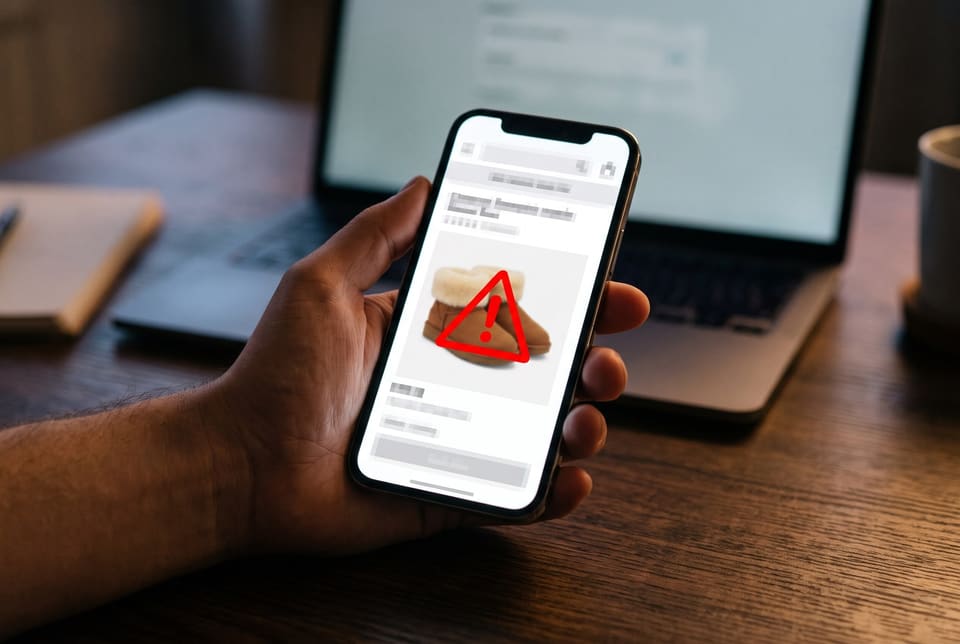
Spotted one of these? You can warn other shoppers by posting a community counterfeit alert, and see what others have reported in our alerts.
The UGG security label
UGG says every authentic product comes with a security feature on a reflective security label. Here is what UGG has described:
- Where it is: sewn into the left shoe or boot, behind the sewn-in size and materials label. If a product has no sewn-in label, look for a security sticker on the sole of the left shoe. For some infant and toddler shoes, the sticker is on the insert card inside the box. Older pairs may also have a security sticker on the shoebox.
- The QR code: UGG has said that labels on products from fall 2013 onward carry a QR code. Scanning it with a phone should take you to a page on ugg.com confirming that the product is genuine.
- The holographic sun: the label shows a sun symbol that switches between black and white when you turn the label about 90 degrees. UGG noted that some fall 2014 products lack the holographic sun but still carry a QR code.
- Older labels: labels from roughly fall 2010 to spring 2013 have the color-changing sun but no QR code, and some from that period show the UGG logo appearing to roll over the suns when the label is tilted.
How to inspect a pair
A side-by-side comparison with the official product photos for the same style and color is the most useful home check. In its consumer advice, Deckers names low quality as a key warning sign, giving synthetic linings, stiff outsoles and sloppy stitching as examples. Look at:
- Lining: classic sheepskin styles are lined with genuine sheepskin, whose fleece grows directly from the hide. Part the fleece gently: you should see suede-like skin at the base, not a knitted or woven fabric backing. Not every genuine product is lined with sheepskin, though. Some styles use textile linings by design, so check the official description for that style. Our materials guide explains the differences.
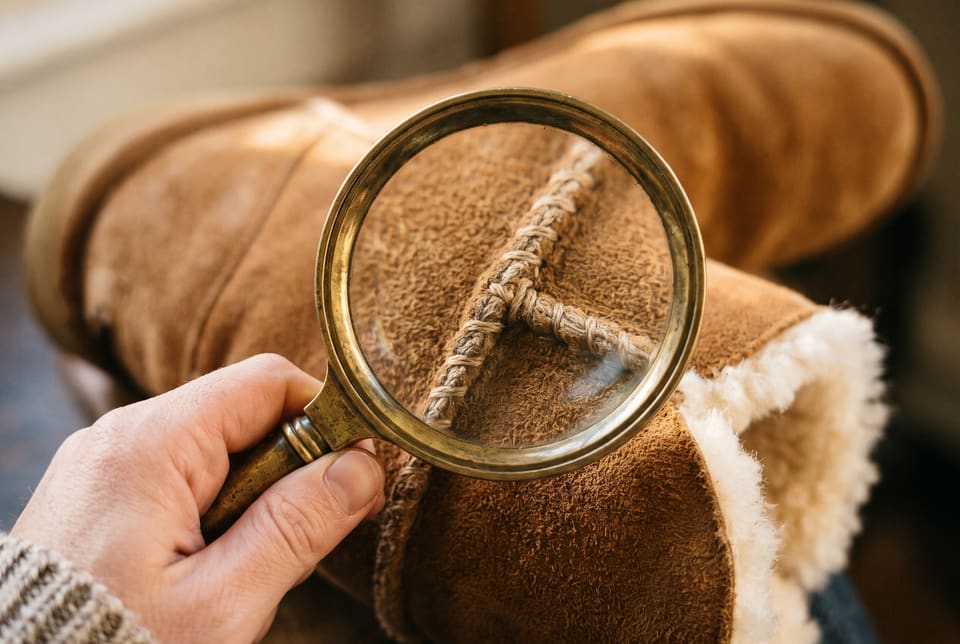
- Stitching: seams should be even and straight, with consistent spacing and no loose ends, glue marks or puckering.
- Sole: the outsole should be cleanly molded, with crisp edges and logo details. Deckers lists stiff outsoles as a sign of a fake, so an unusually rigid, heavy or rough sole deserves a closer look.
- Logos and heel label: lettering should be crisp, evenly spaced and straight. Compare the font, size and placement with the official photos. Current products use the "UGG" name; pairs made before the brand dropped "Australia" in the mid-2010s may say "UGG Australia" (see our history).
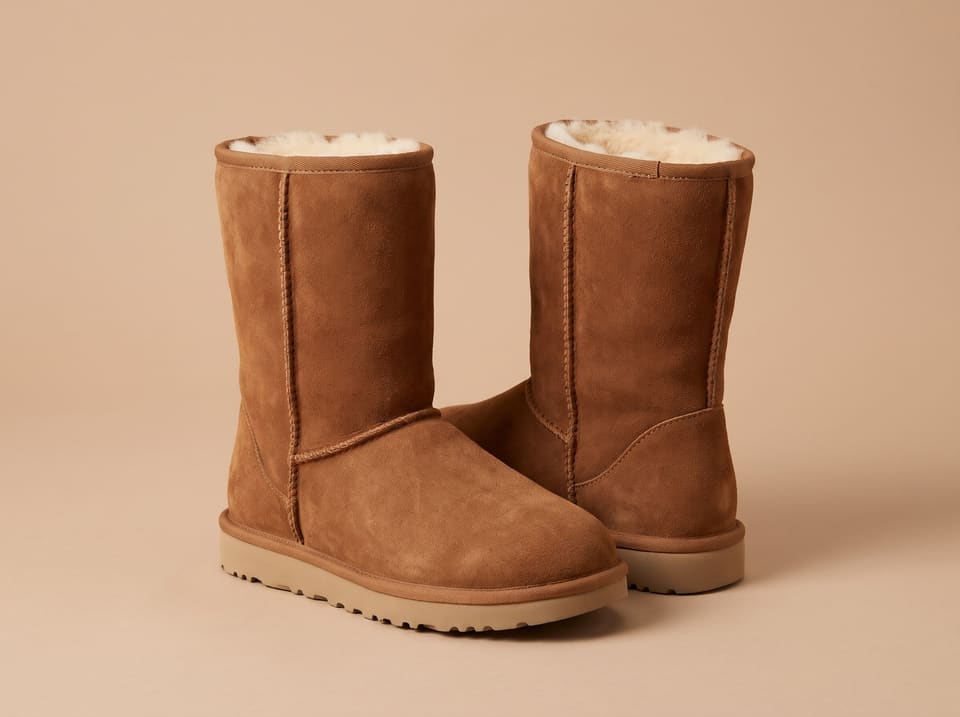
- Shape: fakes often get the height, shaft width or toe shape slightly wrong. Compare the silhouette from the side.
- Labels and box: printed labels should be legible and free of spelling mistakes, with the size and style information matching what you ordered. The box should be sturdy and its label should match the pair inside. Packaging can be faked, and secondhand pairs often come without a box, so it is supporting evidence only.
Buying secondhand
Ask the seller for clear photos of the actual pair, including the security label straight-on and tilted, the inside size label, the sole and the heel. Ask whether the QR code scans to ugg.com. Pay through a platform or method that offers buyer protection, and walk away from anyone who will only accept a payment you cannot reverse.
What to do if you bought a fake
- Keep the evidence. Save the listing or web page (screenshots with the address visible), your order confirmation, messages with the seller, payment records and the product and its packaging.
- Contact the seller in writing. Explain the problem factually and ask for a refund. Keep a copy of everything you send.
- Use the platform's buyer protection. Most large marketplaces have one. For example, eBay's Money Back Guarantee covers items that are not as described, and eBay says that when there are strong indications an item is counterfeit, the buyer may not have to ship it back. Requests generally have to be opened within 30 days of delivery, so act quickly. Amazon's equivalent is the A-to-z Guarantee. Check each program's current rules and deadlines.
- Dispute the payment. If you paid by card, contact your card issuer. In the United States, the Federal Trade Commission explains that under the Fair Credit Billing Act you can dispute charges for goods that were not delivered as agreed, and your written dispute must reach the issuer within 60 days after the first bill containing the charge was sent to you. Payment services such as PayPal run their own dispute processes. UGG's help pages say it can only help with disputes for orders placed on its own website, so for anything bought elsewhere, go to the seller, the platform and your bank.
- Report the website or seller to UGG. UGG's help center asks people to email the address of a suspected counterfeit website to [email protected]. Its Counterfeit Education page has more guidance.
- Report the listing to the marketplace using its report button, so it can be investigated and removed.
- Tell the authorities. In the US, you can report online shopping fraud to the FTC at ReportFraud.ftc.gov and counterfeit goods to the National IPR Coordination Center. In other countries, contact your national consumer protection or fraud-reporting agency.
- Warn others. Post a community alert describing what you saw. Stick to facts you can support; our Community Guidelines explain how.
Don't resell a pair you know or suspect is fake. Doing so can break marketplace rules and, in many places, the law. eBay, for example, requires buyers refunded for counterfeit items not to sell them on.
"Australian-made ugg boots" are a separate issue
Many companies, especially in Australia, make sheepskin boots and sell them under their own brand names. In Australia, "ugg boot" is a common name for that type of footwear. These products are not counterfeit UGG products: they are different brands, and many are made from genuine sheepskin.
The complication is trademark law. UGG is a registered trademark of Deckers in the United States and many other countries, so selling boots described as "UGG" or "ugg boots" in those places can raise trademark problems even when the boots are genuinely made in Australia. In 2019, for example, a US jury found that an Australian boot maker that had sold boots to US customers online had willfully infringed and counterfeited the UGG trademark. That question is about how a product is labeled and where it is sold, not whether it is a fake copy of an UGG product. Our trademark guide explains the background, including the court cases. When you file a report on this site, please don't describe another brand's boots as counterfeit UGG products just because they are called "ugg boots".
How big is the counterfeit problem?
Deckers has published figures over the years that give a sense of scale. In 2014, UGG said it had received more than 80,000 emails about counterfeiting from customers over the previous two years. In 2015, Deckers said law enforcement had seized more than 2.5 million counterfeit UGG products worldwide between 2007 and 2015, and that the company had taken legal action against 60,000 websites selling counterfeits. Those numbers are from years ago, but Deckers' latest annual report still describes the company as a target of counterfeiting and product imitation, which is why the checks above matter.
Frequently asked questions
Where is the security label on UGG boots?
UGG says the reflective security label is sewn into the left shoe or boot, behind the sewn-in size and materials label. If there is no sewn-in label, look for a security sticker on the sole of the left shoe. For some infant and toddler shoes, it is on the insert card inside the box.
Do all genuine UGG products have a QR code?
UGG has said that security labels on products from fall 2013 onward carry a QR code that leads to a verification page on ugg.com. Older pairs have different features, such as a holographic sun that changes color when tilted. Because features vary by season and codes can be copied, combine the label check with the other checks in this guide.
Are UGG boots sold on marketplaces real?
Some are and some are not; it depends on the seller. Prefer listings from the brand or from retailers you recognize, check the seller’s history, ask for photos of the actual pair and its security label, and pay only through methods with buyer protection.
How do I report a fake UGG website?
UGG asks people to email the address of a suspected counterfeit website to [email protected]. Also report the listing to the marketplace or platform where you found it, and you can warn other shoppers by posting a community alert on UGG Review.
Will UGG refund me for fake boots I bought elsewhere?
UGG’s help pages say it can only help with disputes for orders placed on its own website. For purchases elsewhere, ask the seller for a refund, use the marketplace’s buyer protection and contact your card issuer or payment provider to dispute the charge.
Are Australian-made ugg boots fake UGGs?
No. Sheepskin boots sold under other brand names are different products, not counterfeits. Selling them as “ugg boots” can raise trademark issues in countries where UGG is a registered trademark, which is a separate question explained in our trademark guide.
Sources
- UGG: How to Spot Fake UGG Products (Counterfeit Education)
- UGG UK: Authenticity and Counterfeit Protection (help center)
- Deckers Brands: "Buying Real UGG Product, Know the Facts" (Nov. 30, 2016)
- Deckers Brands: "UGG Turns Up the Heat on Counterfeit Protection" (Nov. 23, 2015)
- UGG Australia via PR Newswire: "Ensure Authenticity" (Nov. 25, 2014)
- eBay Money Back Guarantee policy
- FTC: Using Credit Cards and Disputing Charges
- FTC Consumer Advice: online orders that never arrive (Mar. 2023)
- National IPR Coordination Center: report IP theft
- Deckers Outdoor Corp. Form 10-K for fiscal 2026 (counterfeiting risk)